V-Markt Express
Pilot demonstrates the potential of networked checkout services in large-scale retail settings
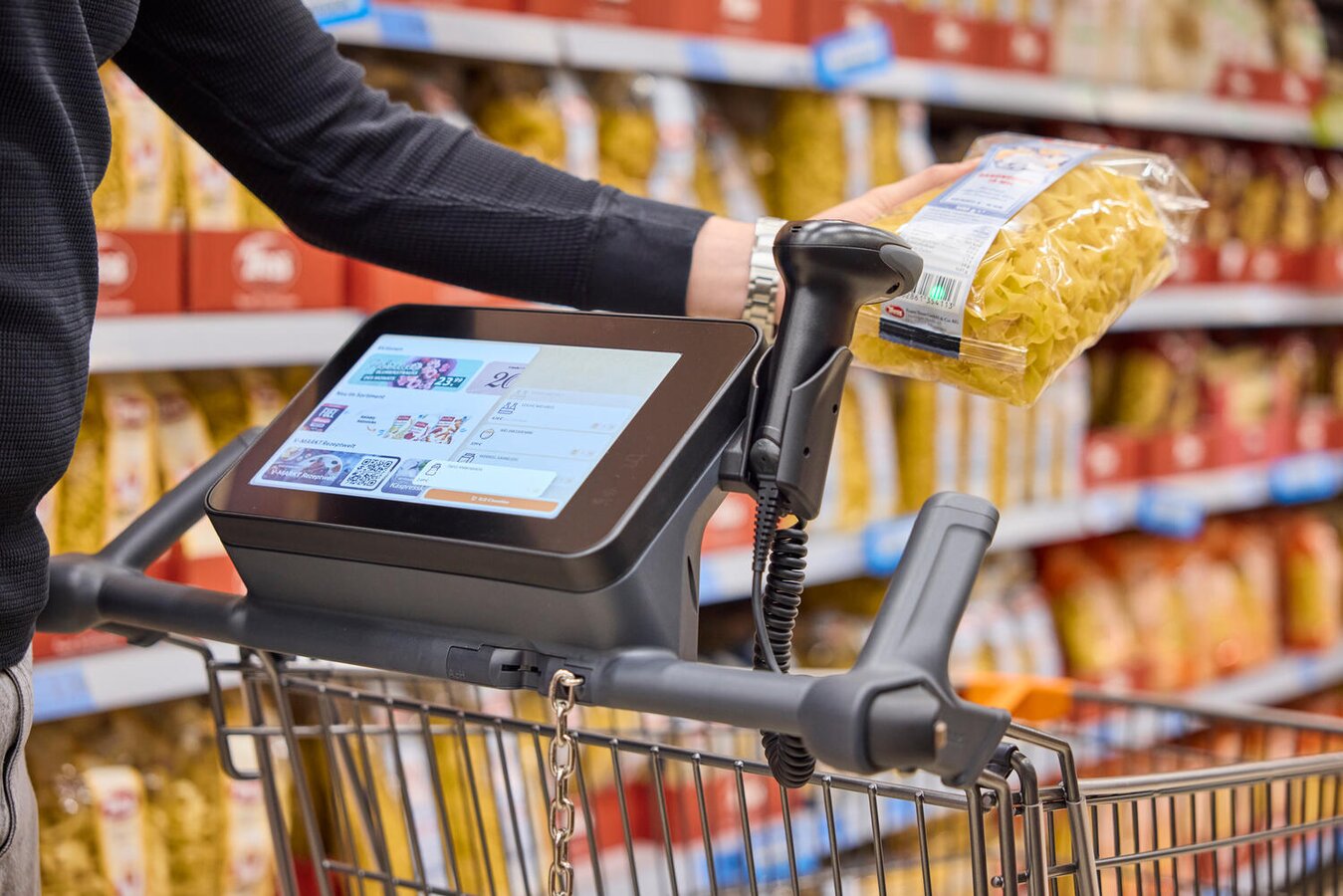
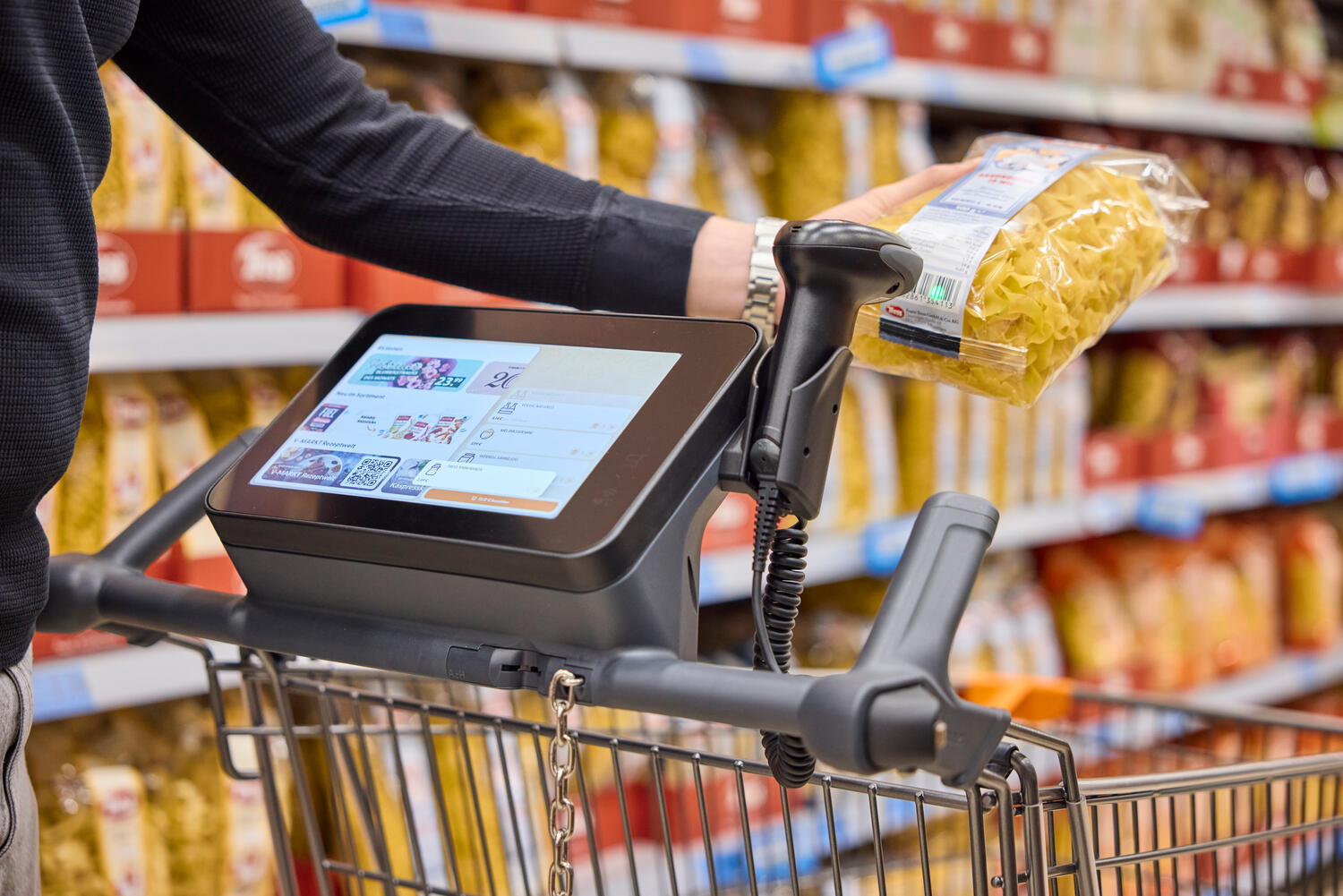
Following a practical test of the FastLaner® in Munich, Wanzl’s overall verdict was positive, revealing a high level of customer acceptance and high resulting usage rates. In addition, a concept has been developed for retail media integration in the smart shopping trolley. The first practical test of the V-Markt Express at the V-Markt store in Munich’s Euro-Industriepark district has been completed. The pilot project has provided an important insight into the further development of networked self-checkout and express services in large-scale retail settings. The focus of the project was on the interaction between several checkout formats in day-to-day business: FastLaners®, mobile handheld scanners, stationary self-checkout terminals and Smart Exit units.
Reality check for large-scale retail settings
The location was deliberately chosen to be challenging. Covering an area of around 17,000 square metres of retail space, it has roughly 300,000 listed products, combining food, non-food, a DIY store and self-service counters, and also has its own container processes, peak times and a variety of different shoppers. It was precisely this level of complexity that made the store on Maria-Probst-Strasse in Munich the ideal test environment. The intention behind the new express services is to demonstrate how technology, store workflows, customer use and employee perspectives interact, not under laboratory conditions, but in everyday life at the store. “The pilot project has shown that express services are particularly relevant in large-scale retail settings if they are designed to work as a networked system,” says Stefan Huemer, Vice President Digital at Wanzl. “For us, it was crucial not to look at how the solutions worked in isolation, but at how they interacted with store workflows, technical stability and customer guidance systems. These findings are directly incorporated into enhancements to the FastLaner® and future checkout concepts.”
High acceptance and good usage rates
The latest appraisal clearly reveals a fundamental openness towards the new offers. It was based on 14,600 sessions from February to mid-July with an average shopping time of 23:31 minutes. In terms of mobile express services, handheld scanners accounted for 62.6 percent of use and the FastLaner® for 37.4 percent. As such, the intelligent shopping trolley achieved relevant usage rates during day-to-day life in the store and was perceived as more than just an innovative format. Customer acceptance was also reflected by repeated use: 30 percent of FastLaner® users and over 61 percent of self-checkout users used the respective offer more than once during the pilot period. Over 80 percent of respondents found the express services useful to very useful and intuitive to use. In addition to saving time, other factors played an important role, including curiosity, the fun of trying something new, the feeling of being addressed directly and support during the introduction phase. “For day-to-day store operations, it is crucial that new services make shopping easier, not more complicated,” says Dominik Endres, IT and project manager at V-Markt. “The results show just how important freedom of choice is: Customers were able to decide for themselves whether to check out at a traditional till, use a stationary self-checkout, shop with a handheld scanner or use the FastLaner®. At the same time, the pilot project confirmed that personal support is a key factor for success, especially in the early stages.”
Insights from ongoing operations
What else did the pilot project reveal? It showed that the services weren’t used just for quick, convenient purchases. Over 17 percent of the sessions lasted longer than 45 minutes. In addition, internal evaluations indicate that shopping baskets contained more items when mobile express services were used. During the pilot period, the total value of purchases was in some cases significantly higher than previous comparable figures from before the new services were introduced. In addition to usage and acceptance, the pilot project clearly highlighted which factors are crucial to the operation of networked express services. These include freedom of choice, employee involvement, system stability and active customer approach. During active operations, Wi-Fi stability, scanning processes, transfers into cashier processes, special applications such as fuel vouchers and item and promotional price recognition were identified as points where the technology and operations could be improved. These issues were quickly analysed during the course of the project and optimised together with the partners. “In a project under realistic conditions, it quickly becomes clear how important stable processes and clean integration really are,” says Günther Glogger, Head of Development & Project Management at DRS. “We gained some valuable insights for future operations and technical development, particularly when it came to learning how different checkout formats interact with existing processes.” Mobile user guidance was also a key factor for success. New services not only need to work well on a technical level, but also need to be intuitive and understandable for customers and fit in well with the shopping situation in question. “To be well received, the benefits of mobile checkout services need to be immediately obvious” says Nico Müller, CCO of shopreme. “The positive verdict and recurring usage show how important simple user guidance, clear processes and a coherent mobile experience are for the acceptance of these services.”
Spotlight shifting to retail media
An additional area of knowledge is retail media on the shopping trolley. During the course of the project, focus shifted towards this topic. Fitted with a display, the FastLaner® is able to act as a digital extension to traditional flyers, integrating product recommendations directly into the shopping process and establishing new forms of communication with industry partners at the point of sale. During the pilot phase, Wanzl and V-Markt implemented the technology and design features needed for a practical retail media concept for the FastLaner®. Stephanie Jordan, Business Development Manager Digital & New Biz, emphasises that handling needs to fit in well with the retailer’s day-to-day routines: “When it came to the design process, the core goal was to develop a retail media concept that could be implemented quickly with as little effort as possible, while also being economically viable. The traditional flyer was deliberately chosen as the starting point, with the aim being transfer its content to the digital shopping trolley. The goal was to demonstrate how existing retail communication can be efficiently transferred to a new retail media channel. At the same time, the concept opens up potential for context-based offers, effective targeting, new tooling models and systematic success tracking. As ever, the decisive factor for long-term success is to ensure that the content offers tangible added value for end consumers and integrates seamlessly into the shopping experience.” After the end of the pilot phase, the systems will continue to be used until the end of 2026.